|
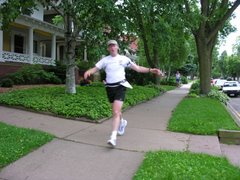
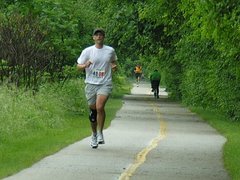
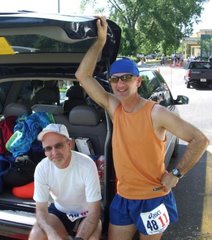
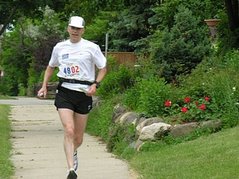
| Fred Bounds in 2009 Madison-Chicago relay |
Sunday, April 29, 2012
Speedy Half Marathon for 2009 Stranger Fred Bounds

Saturday, April 28, 2012
Training tip - Multi-run days
Add a couple of multi-run days to your training schedule a few weeks before the race. Count backward four weeks prior to the race and add one multi-run day four weeks out, one three weeks out, and two two weeks out. The last week before the race should be a mini-taper, resting up for the race.
In order to keep yourself from getting injured, you want to keep these runs short. Perhaps 3 to 4 miles each. Run them at your race pace, or a little faster, and make sure that you have at least 8 hours recovery between them. Put these in the middle of the week, say on Wednesday, out of the way of your more critical long runs on the weekends. (credit: coachjoeenglish.wordpress.com)
A Madison-Chicago (MC200) runner wrote in 2009: “If you now train 3 times a week, 5-7 miles, with some hills, you are close to ready. The tough part is self-control. You need to pace over a 48-hour period anticipating little or no sleep. The fight is three rounds, and between rounds you have to rest when you can. Most common runner mistake I've seen is nervous over-drinking and over-eating of 'race fuel' type stuff.” Another runner added: “And don’t forget the adrenaline factor – you’ll be amazed at what your body can do with very little sleep.“
Rank Stranger trivia: The only runner to run the same leg 6 times Mark (1, 13, 25). Others who have run the same leg more than 3 times: Jeff 4 (leg 6, 18, 30) and Eric 4 (31) 3 (19, 24).
Saturday, April 21, 2012
Rank Stranger tip - off cycle running
Don’t let the Madison-Chicago relay catch you off guard. Whether you are a morning or evening runner the relay will challenge you with a run at a time that is NOT familiar to you.
Practice by starting a run at least 8 hours from your normal run time. I normally run early in the morning, so part of my relay practice is a late afternoon run. This gives me a sense of how my body, especially my stomach, responds. Ideally, keep your normal run too so you have two runs on the day of this dress rehearsal. (Review the Rank Stranger tip about multi-run days).
Speaking of the stomach…it is important that you know the answers to these questions:
1. What is the right pre-run meal for you? How much food is enough to give you the energy you need?
2. How much time do you need to digest your meal?
Answers are specific to YOU – what works for me might not work for you.
Finally, talk with your van-mates about everyone’s requirements for meal stops – make the most of restaurant meals and convenience store raids.
During the race, if you can fit in regular meals near your normal eating times, do it. You should eat right after you run a leg to provide the food time to settle. Avoid eating large quantities of protein or fat which will not digest well.
Rank Stranger trivia: Rank Strangers boasts two iron man triathletes, Holly Dowling and Martin Tagge. Both have done heavy duty in the relay; they are near the top of the RS list for average miles per year. (Martin is first with 21.3 miles per relay, Holly next with 19.8).
Practice by starting a run at least 8 hours from your normal run time. I normally run early in the morning, so part of my relay practice is a late afternoon run. This gives me a sense of how my body, especially my stomach, responds. Ideally, keep your normal run too so you have two runs on the day of this dress rehearsal. (Review the Rank Stranger tip about multi-run days).
Speaking of the stomach…it is important that you know the answers to these questions:
1. What is the right pre-run meal for you? How much food is enough to give you the energy you need?
2. How much time do you need to digest your meal?
Answers are specific to YOU – what works for me might not work for you.
Finally, talk with your van-mates about everyone’s requirements for meal stops – make the most of restaurant meals and convenience store raids.
During the race, if you can fit in regular meals near your normal eating times, do it. You should eat right after you run a leg to provide the food time to settle. Avoid eating large quantities of protein or fat which will not digest well.
Rank Stranger trivia: Rank Strangers boasts two iron man triathletes, Holly Dowling and Martin Tagge. Both have done heavy duty in the relay; they are near the top of the RS list for average miles per year. (Martin is first with 21.3 miles per relay, Holly next with 19.8).
Boston Marathon - Rank Stranger report
 |
| Rank Strangers weren't defeated by blazing heat at the Boston Marathon. |
Jennifer Sell and I just ran a very hot Boston marathon on Monday. The race was sandwiched between two beautiful spring days. The marathon gods reserved 89-90 degree sunny weather for marathon Monday. Thank goodness relay teammate Jennifer was there to run with...I'm not sure I would have finished without her company. We ran slow and smart and enjoyed the spectacle that is the Boston marathon.
Race support was outstanding. There were thousands of smiling, enthusiastic volunteers handing out Gatorade and water. And the spectators lined the route for all 26.2 miles cheering us on and handing out oranges, water, and blessed ice. Running slowly allowed us to ignore our watches and focus on the event around us. For me, even though this was my slowest marathon, I think it was the most emotionally rewarding.
My next venture is a 100-mile bike ride around Lake Tahoe the weekend before the Chicago RAGNAR relay. I'm coaching a team of cyclists from Madison who are raising money to support leukemia research and patient services. In addition to coaching, I'm also fundraising and I hope you will support my efforts by making a donation of any amount at http://tinyurl.com/ride2cure.
Your donation makes a difference in the lives of blood cancer patients and their families.
I'm looking forward to this year's relay. Thanks for your support!
--Art
Friday, April 13, 2012
Rank Stranger tip - pacing
Don’t expect to run at “personal best” pace in the MC200. The relay routine is not conducive to top performances: from a physiological standpoint, the time between legs is inadequate for complete recovery and restoration of energy stores. Studies have shown that complete restoration of muscle glycogen in runners’ legs takes as long as 48 hours.
Consider the following pace advice from coachjoeenglish.wordpress.com:
Run a pace that is close to what you would expect to run for the full distance of your combined legs. Think of it as one long run that is split into three segments with a long rest in between. If you would not be capable of running all three legs consecutively at a particular pace, then that pace is probably too fast for you. You’ll most likely burn up on the third leg.
Some people have success using their half-marathon pace target. This is slower than your 10K pace, but faster than your marathon pace. It falls somewhere in the middle. It should be quick enough to challenge you and make you competitive, but also be a good pace to sustain across all three legs.
Once you’ve dialed in your pace, you need to make sure that you get comfortable running that pace. You should get in 1-2 runs each week at that target pace. Just as you would for a marathon, or any important race, you want to practice your target pace and memorize what it feels like. This is so important for a race when you’ll get an adrenaline rush when you take the baton and you will be tempted to go out like you’ve been shot from a cannon. Learn your pace. Ingrain it into your head. Be ready to run your target pace, while ignoring what the other runners are doing around you.
---
Rank Stranger trivia: Keith Dudding earned the title of iron man of Rank Strangers in the first relay, 2005. Keith holds records for most miles in a single relay (28.8) and also has the two longest runs, 11.7 and 10.7 miles. The long runs each spanned two legs -- he was doing extra duty in a short-handed van#2. Eric, who was in Van #2 with Keith in 2005, came closest to Keith's total mile record with 26.6 miles in 2009, running 4 single legs. Dave Maze totalled 24.7 miles in 4 legs in 2007.
Sunday, April 8, 2012
Rank Stranger tip - training distance
For Madison-Chicago relay training, don’t focus on the total distance of your legs as an endurance target. You might think that if a runner needs to run a combined 18 miles (6 miles x 3) they should really get in at least an 18 miler prior to the event. While that endurance base might be helpful, what is really more important is to run a fair amount of mileage at your target race pace and focus on running that pace for a distance slightly longer than the longest of your race legs. So if you’re running a 5, a 6 and an 8 mile leg, then you want to be able to comfortably cover 9 or 10 miles at your race pace. (See next week's Rank Stranger tip on pacing for more advice. It says your pace should be appropriate for your total relay mileage).
Remember, the tough aspect of running in a relay is not so much the distance, but rather the short recovery time between the runs. Added to that is the fact that most runners will run too fast, especially in their first leg, which means they will be especially tired going into their second or third runs. (credit: coachjoeenglish.wordpress.com )
--
Rank Stranger trivia: Nine Rank Strangers have had runs of more than 8 miles: Keith (2), Kim (2), Randy (2), Marc G. (2), Martin (2), Holly, Steve H., Ed S., Jeff. The 8+ milers: Keith 11.7, Keith 10.7, Kim 9.9, Randy 9, Martin 8.8, Holly 8.6, Steve H. 8.6, Randy 8.6, Marc G. 8.4, Kim 8.4, Marc G. 8.2, Martin 8.2, Ed S. 8.2, Jeff 8. (Keith’s long runs spanned multiple legs; the others were single legs).
Subscribe to:
Comments (Atom)